Britain put roughly 1.42 million tonnes of new textile products onto the market in 2022 and generated approximately 1.45 million tonnes of used textiles. Those two figures being nearly identical is the whole problem in miniature: the country consumes and discards clothing at almost exactly the same rate, with very little of it staying in use long enough to break the cycle.
What happens to the discarded material is worse than most people assume. Around 711,000 tonnes of textiles ended up in residual waste in 2021 — the ordinary rubbish bin. Of that, 84 per cent was incinerated and 11 per cent landfilled. A further 421,600 tonnes were exported. The figures come from market analysis published by WRAP in March 2024, and the incineration share is the number that tends to surprise people who conscientiously separate their recycling.
Progress on carbon, not on volume
The UK Textiles Pact reported in October 2025 that volumes placed on the market were 17 per cent higher in 2024 than in 2019. Carbon intensity per tonne fell by 6 per cent over the same period — a real improvement in how efficiently textiles are produced — but total carbon rose 10 per cent, because the volume growth swamped the efficiency gain. Recycled fibre content among signatories climbed from 2 per cent to 16 per cent, a genuinely significant shift, and signatories handled 210,000 tonnes in 2024.
This is the recurring shape of textile sustainability data: per-unit metrics improve while absolute impact grows. Making each garment 6 per cent less carbon-intensive achieves nothing if 17 per cent more garments are sold, and no amount of recycled polyester changes that arithmetic.
No producer responsibility scheme — yet
Unlike packaging and electrical goods, textiles are not covered by an extended producer responsibility scheme in the UK. This means the cost of collecting and disposing of clothing falls entirely on local authorities and, ultimately, council taxpayers rather than on the businesses placing the products on the market.
WRAP’s circularity blueprint, published on 28 January 2026, projects that local authority costs for handling textiles could rise from around £73 million to £137 million a year, potentially reaching £200 million by 2035 if nothing changes. That trajectory arrives at exactly the moment council budgets are least able to absorb it. The broader waste policy framework is set out in the government’s waste prevention programme for England, which identifies textiles as a priority stream without yet imposing producer obligations.
The wardrobe is where the leverage is
Research from October 2022 found the average British wardrobe contains 118 items, of which 26 per cent have not been worn in at least a year. Repair, meanwhile, extends the retention period of a garment by an average of 1.3 years. That last figure is the most useful number in the entire textile debate, because it identifies an intervention available to individuals that measurably reduces throughput.
Extending the life of clothing is far more effective than recycling it. Textile-to-textile recycling remains technically difficult, particularly for blended fibres, and most material collected for recycling is downcycled into insulation or wiping cloths rather than becoming new clothing. The circular economy analysis published by the Ellen MacArthur Foundation makes the same point: keeping garments in use outperforms every downstream option.
Repair as a visible movement
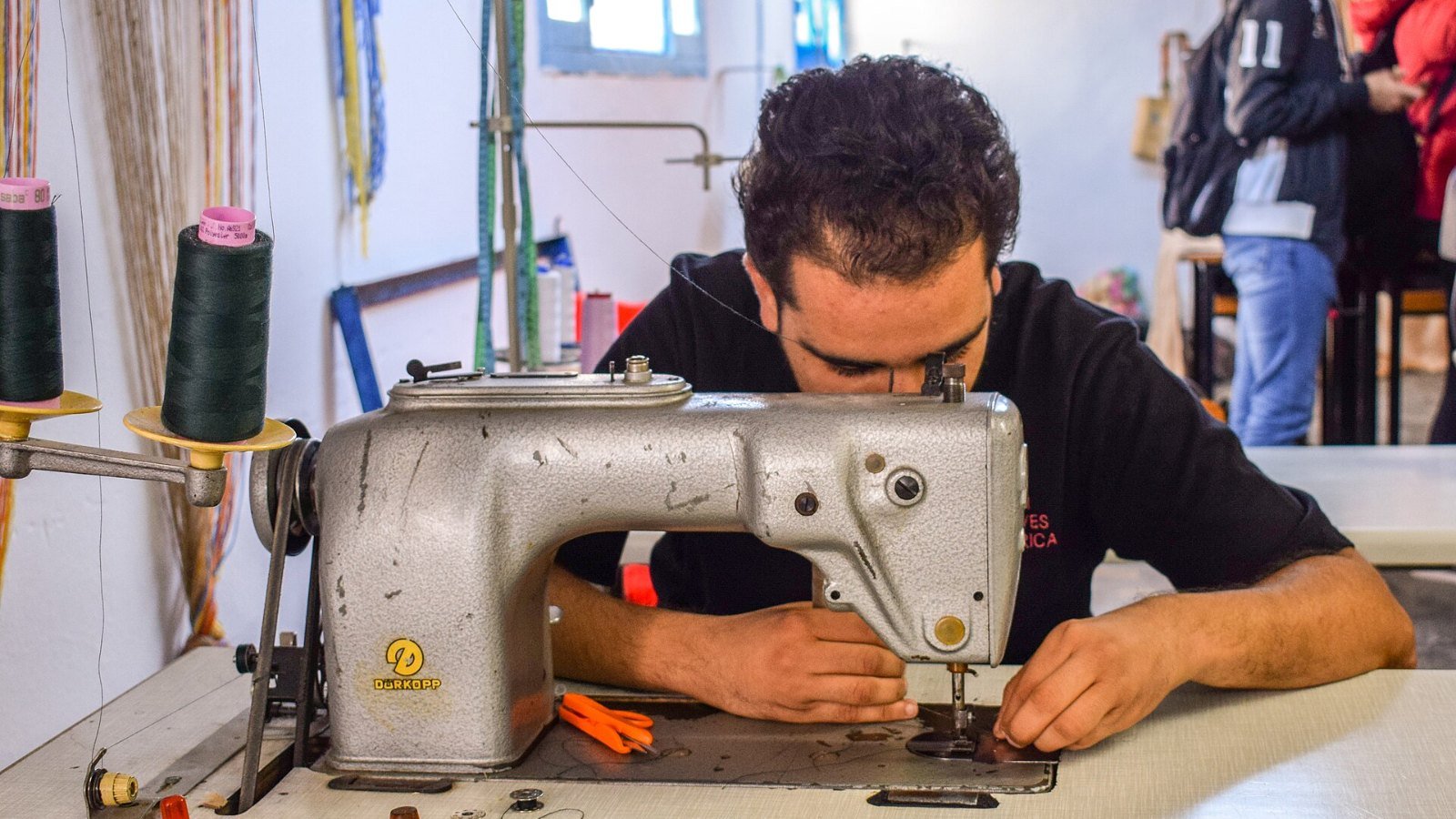
The revival of repair in Britain has been quiet but measurable. Repair cafes operate in hundreds of communities, offering free or low-cost mending alongside tools and instruction. Several major retailers now offer repair services or resale platforms for their own products. Visible mending — darning and patching done decoratively rather than invisibly — has become a recognisable aesthetic rather than an admission of thrift.
The economics have also shifted. When a garment cost very little and a tailor’s time cost comparatively more, repair was irrational for most items. As clothing prices have risen and mending skills have become more widely shared through online instruction, the calculation has changed for mid-priced garments — a coat, a pair of boots, a knitted jumper. It has not changed for the cheapest end of the market, where replacement will remain cheaper than repair under any plausible scenario.
Which is why individual behaviour, however admirable, will not resolve this. Repair culture reduces the throughput of people already inclined to reduce it. The 711,000 tonnes going into residual waste and being burned is a systemic outcome, and systemic outcomes are changed by producer responsibility rules and collection infrastructure. Britain currently has neither for textiles, and a rising bill arriving at local authorities that cannot pay it.
Why this matters to UK readers
Readers comparing products or trends should look beyond a single launch or social-media cycle and consider materials, durability, sizing, care requirements and total cost. Availability and pricing can vary across the UK, so current retailer information remains the final reference.
PR Press will continue to review developments related to Britain’s Textile Waste Problem and the Rise of Repair Culture and update the coverage when reliable new information becomes available.
Sources and further reading
- WRAP (wrap.ngo)
- waste prevention programme for England (gov.uk)
- Ellen MacArthur Foundation (ellenmacarthurfoundation.org)